
To comply with updates to the California Beverage Container Recycling Program for January 1, 2024, Commerce7 will automatically calculate and apply the California Redemption Value fee to applicable orders.
In this Article
How the CRV is calculated on Orders
Setting up CRV in ShipCompliant
How the CRV is calculated on Orders
- If an order has a California shipping address or California pickup or carryout location, a CRV fee will automatically calculated and applied to the order. (No setup is required on your end).
- For each bottle in the order:
- For every wine bottle with less than 24 ounces, $0.05 will be added
- For every wine bottle over 24 ounces, $0.10 will be added
- The combined fee across all items in the order will display as "CRV" in the order summary. The customer will see the fee listed on their receipt and in transaction emails.
What about On-Site Consumption and $0.00 Orders?
You have the ability to adjust the charge amount for the CRV fee if necessary for onsite pours on an Order-by-Order basis. The same goes for $0.00 Orders (like donations). If a customer plans to consume wine on-site - and also wants to purchase bottles to take with them, it is important to note that these will need to be placed as two separate orders.

Additionally, the CRV fee will only apply to Products with a Product Type of "Wine". So if you set up your tasting room samples with a Product type of 'Tasting', then the CRV would not be calculated for those SKUs.
Collecting Tax on the CRV Fee
The CRV fee now supports tax collection. You can turn this setting on or off until November 30, 2026. After that date, we’ll remove the temporary settings, and the CRV fee will automatically collect tax.
Collect Tax Setting will be 'Off' by default
The Collect tax setting controls whether tax is charged on top of the amount collected.
- If the setting is 'Off', the CRV fee will not collect tax, and all integrations will work exactly like they do today.
- If the setting is 'On', the CRV fee will start collecting tax, and therefore require code changes for integrations, if applicable.
- Clients that don’t use integrations that pull in this fee can turn on (or off) the setting at any time.
- Any integrations that currently pull in the CRV fee, will need to update their integration to pull in the new code. Developers can learn more here.
Accessing the Collect Tax Setting
- Go to Settings > Taxes > Custom Taxes > CRV.
- Click on Custom Fees.
- Click on the CRV Fee.
- Toggle the Collect Tax button and Save.
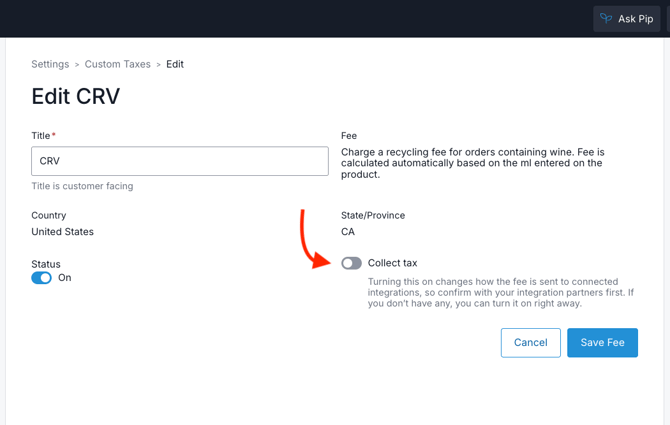
Setting up the CRV fee in ShipCompliant
The CRV fee now correctly collects tax on top of the CRV amount.
Because this amount is no longer sent over to ShipCompliant as a tax, ShipCompliant requires a “Key” to be created, otherwise it will give an error when checking compliance: “Product matching given BrandKey/ProductKey is not available [,CRV]“.
Setting up the Key in ShipCompliant
-
Log into ShipCompliant.
-
Go to Setup > Products.
-
Add a Product.
-
Select the Product Type of General Merchandise.
-
Enter a Key of CRV.
-
Select your Supplier and Brand. (The rest of the details can be left blank).
-
Click Save.
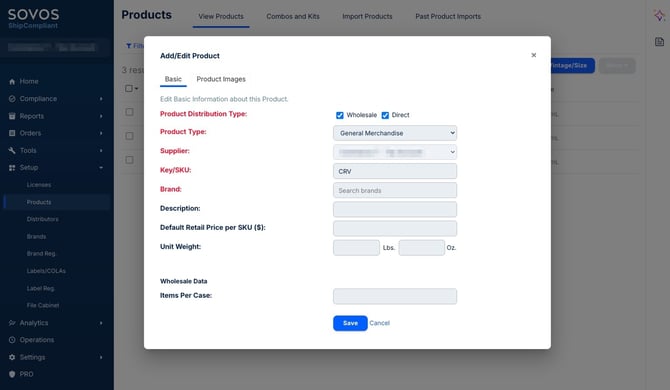
Note: You only need to set up one CRV product, even if you have multiple brands. Brand information isn’t sent through the ShipCompliant integration, so the fee will pass through correctly as long as a product with the Key 'CRV' exists.
If you have questions about how to make this change in ShipCompliant, please reach out to ShipCompliant's support for assistance in updating it.
Reporting
-
How can I view the total amount charged for the CRV fee only?
-
Go to Reports > Finance Reports > Tax Report.
- If the CRV fee has been charged for any orders within your selected date range, you'll see it listed as a row in the report.
- Click Email Report the top to be emailed a CSV file.
- You can also see a daily summary of the CRV fee charged from the Reports > Order Reports > Closing Report.
-
- How can you report on bottle quantity?
Head over to the Reports > Finance Reports > Tax Compliance Report This will give you both bottle quantity and mL. - How can I report on CRV per order?
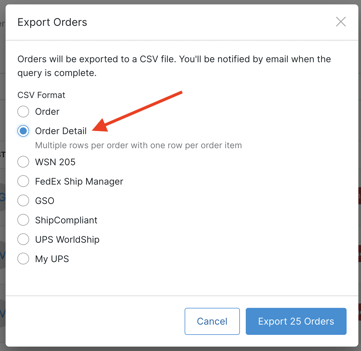
Go to Store > Orders where you can do an Order Export (with Details). This will give you SKU(s) + qty + Tax + CRV per Order. - How can I query to isolate CA Orders (for wineries located in CA)?
Specifically for wineries in CA, the following Query will pull all Orders which were charged the CRV.


Attention Avalara Users
Please note that this fee is currently not compatible with Avalara.